Gross vs. net rental yield: the calculation almost nobody does
Gross yield is a headline; net yield is a decision. Here is the full calculation, with the exact figures we apply to every property in the catalogue.
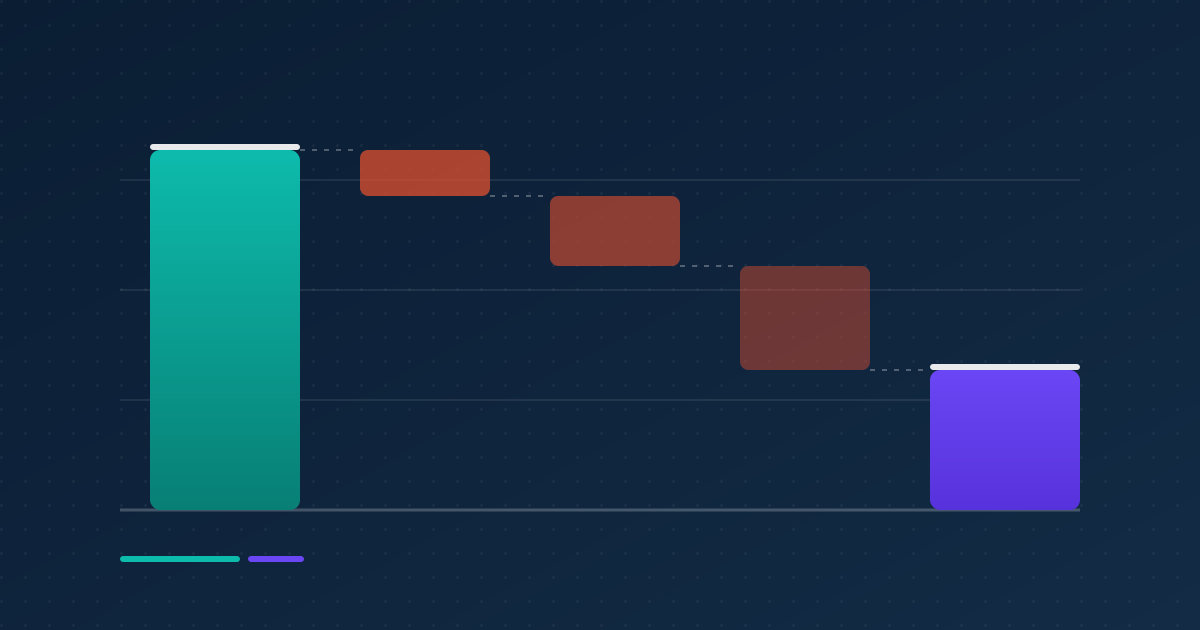
Gross rental yield is the most quoted figure in the industry and the least useful one: annual rent divided by purchase price. It's easy to compute, it's fine for roughly comparing areas, and it has one serious flaw — it describes a property that doesn't exist. One that pays no property tax, no service charge and no special levy, is never empty, never needs a new boiler, and never needed a euro of refurbishment.
Net yield is the same calculation after subtracting what the property consumes and after adding to the price what you actually put in. It usually sits one and a half to two points below the gross figure, and that gap is exactly where a purchase stops or starts making sense.
The three costs that eat the difference
For a dwelling bought to let, our annual cost calculation has three lines, and only three. No more, because we don't want assumptions we can't back with a data point.
-
Estimated IBI (municipal property tax)
We neither invent it nor use a national average: we start from the municipality's reference cadastral value for that property type and area, and apply the urban tax rate the municipality itself publishes. Two identical flats in neighbouring municipalities can pay very different amounts, and that shows.
-
Service charges
When the listing states them, they go in as stated. When it doesn't, the property isn't penalised with an invented figure; what drops is data confidence, not the score.
-
A 15% allowance on rent
A single percentage of gross rent covering what does happen but can't be predicted property by property: void periods between tenants, arrears, routine maintenance and small repairs. For retail units and offices we raise that allowance to 30%, because their voids run longer and their property tax is higher.
The denominator matters too (and it's rarely the asking price)
A common mistake is dividing by the asking price. If the flat needs refurbishing, that price isn't what you invested: it's the first half of the invoice. When the listing states the property needs work, we add a refurbishment allowance of €600/m² to the invested capital — an order-of-magnitude figure for a standard full refurbishment — and compute the yield over the total.
The effect is brutal, and it's the one almost nobody shows: two listings with the same rent and the same price don't return the same thing if one is ready to let and the other isn't.
The full calculation, with a worked example
A 90 m² flat at €120,000, with an estimated market rent of €650/month and a €45/month service charge, in a municipality where its property tax works out at around €240 a year. An ordinary case, not a flattering one.
| Line | Amount |
|---|---|
| Annual rent (€650 × 12) | €7,800 |
| Gross yield (7,800 / 120,000) | 6.50% |
| − Estimated property tax | −€240 |
| − Service charge (€45 × 12) | −€540 |
| − Void, arrears and maintenance allowance (15%) | −€1,170 |
| Net operating income | €5,850 |
| Net yield (5,850 / 120,000) | 4.88% |
| And if it needed work (+€600/m² × 90 m²) | 5,850 / 174,000 = 3.36% |
- 6.50% Gross yield
- 4.88% Net yield
- 3.36% Net yield with refurbishment
A point and a half between gross and net, and another point and a half if there's building work. On €120,000 invested, the distance between the headline and reality is close to €2,000 a year.
From percentage to score points
Net yield is the heaviest factor in the Inmoblia Score: 34% of the total. But it doesn't enter as a percentage, it enters through a saturating curve, because the difference between 2% and 4% matters far more than the difference between 11% and 13%.
| Net yield | Factor points (0–100) |
|---|---|
| 3% | 39 |
| 4.88% (the example above) | ≈ 56 |
| 5% | 57 |
| 9% | 78 |
Those points are then adjusted by how reliable the rent behind them is. A rent we know well keeps 100% of the factor; a medium estimate keeps 90%; a weak one, 70%. And if the rent benchmark isn't from the property's own municipality but from its province or from Spain as a whole, it drops a further 15%: that isn't evidence about this market, it's borrowed from another.
What to do with this number
Net yield isn't a forecast, it's a comparison. It's for ranking a hundred properties down to five, and for knowing what to ask about those five: whether the service charge is the one stated, whether a special levy has been approved, whether local rents hold up, whether the refurbishment is €600/m² or €1,200. That part remains yours, and no platform should pretend otherwise.
Every property report lets you open this same calculation with that property's own figures, change the assumptions and watch it move, and see which source each number comes from. If you want the calculation for a specific dwelling you already have in mind, value it by its exact address.
Frequently asked questions
What's the difference between gross and net rental yield?
Gross yield divides annual rent by the purchase price and subtracts no costs. Net yield subtracts the property's recurring costs — municipal property tax, service charges and an allowance for voids, arrears and maintenance — and divides by the capital actually invested, refurbishment included where the property needs it. For Spanish housing the usual gap is 1.5 to 3 points.
Why use a 15% allowance instead of real costs?
Because voids, arrears and breakdowns are real but not predictable property by property. A single percentage of rent is an explicit assumption that stays comparable across every property; inventing a different figure for each one would be apparent precision. For retail units and offices the allowance rises to 30%, as their voids run longer and their property tax is higher.
Do you include purchase taxes in the yield?
No. Transfer tax or VAT, notary, registry and conveyancing depend on the autonomous community, the seller and your tax position, so a national average would be falsely precise. Add 8%–13% on the price to your own figure for invested capital.
Why doesn't a property with an 18% yield appear in the catalogue?
Because it's almost certainly an error in the listing data. We apply a plausibility ceiling of 15% net for dwellings and 20% for other asset classes: above that we don't score the property, rather than let a bad data point top the ranking.
This article is general information, not investment, tax or legal advice. Rent and value estimates are indicative and carry their own stated margin of error.